
For hardware and software requirements see this topic.
Utilizing an is the fastest path to proficiency in EPLAN Electric P8. By studying professionally designed projects, you gain insight into structuring complex systems, using automated reporting, and adhering to international standards. Whether you are just starting or trying to optimize your current workflows, the sample project is a crucial component of your engineering toolkit.
Starting an electrical schematics project from a blank canvas is highly inefficient. A standard EPLAN sample project serves as a reference blueprint for your engineering team.
Eplan P8 sample projects are invaluable assets for anyone serious about mastering electrical design using EPLAN Electric P8. Whether you are just starting your journey with the built-in demonstration project, exploring open-source templates to accelerate your workflow, studying real-world engineering examples to understand best practices, or diving into advanced integration scenarios involving PLC data exchange and 3D cabinet layout, sample projects provide the hands-on experience that accelerates learning and improves design quality. Eplan P8 Sample Project
Populate your sample project with window macros ( *.ema ) and page macros ( *.emp ) for common circuits like DOL motor starters or VFD drives.
Instead of starting from a blank page, you can reverse-engineer a fully functional design to understand how EPLAN handles connections, devices, and reports. Utilizing an is the fastest path to proficiency
The default EPLAN sample is generic. To achieve real ROI, you need a .
Project metadata, customer info, and revision history. Starting an electrical schematics project from a blank
Defines the plant or system section (e.g., ==A1 for Assembly Line 1).
Experienced users know that the contains teaching elements beyond the obvious schematics:
Delete the existing terminal diagrams or BOM pages from the sample project. Then, navigate to Utilities > Reports > Generate . Re-generate the reports to see how Eplan instantly compiles data from the schematic pages into production-ready documentation. This teaches you the power of Eplan's automated backend. Step 3: Trigger and Fix Message Classes (Error Checking)
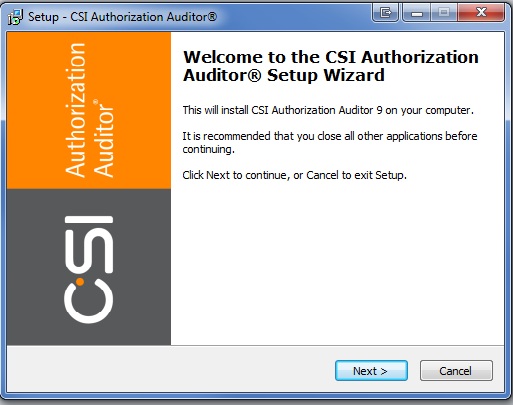
Click next on the welcome screen in order to continue.
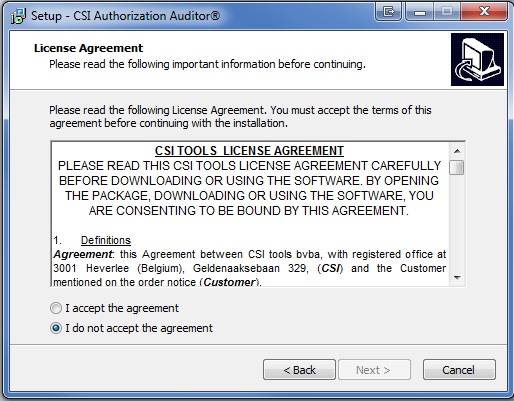
We advise you to read the license agreement before clicking 'I accept the agreement'. Click next to continue.
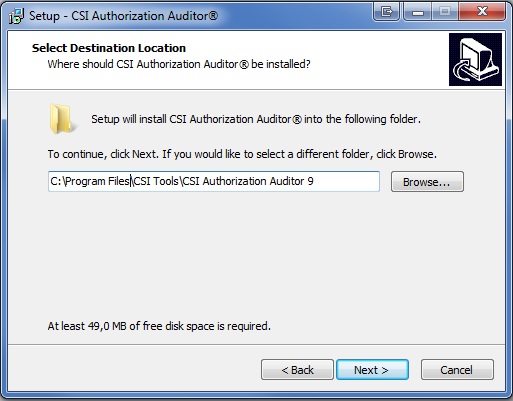
Choose a valid destination folder and click next. If the destination folder does not exist yet, a pop-up dialog asking you whether you want to create the directory will be displayed. Click next to continue.
Note: When installing the Access 2007 or 2010 version of the CSI Authorization Auditor, please make sure that the destination folder is a trusted location.
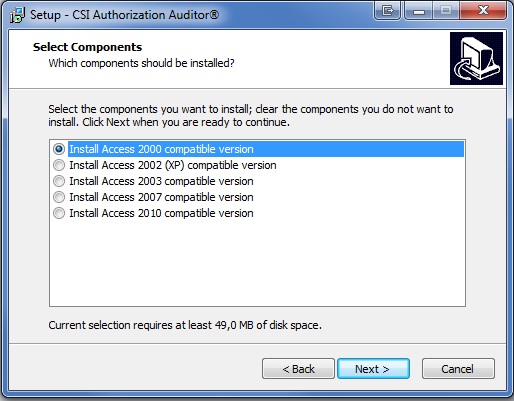
Select which Access-specific version of the CSI Authorization Auditor you wish to install.
Click next to continue.
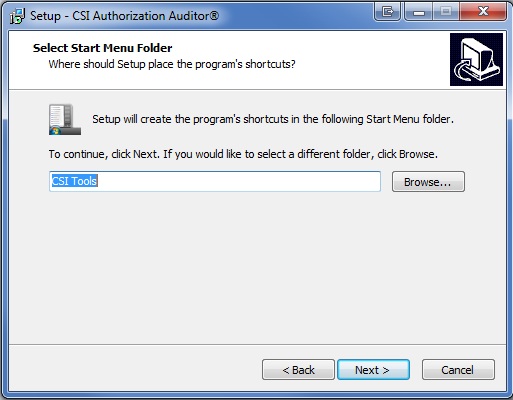
An entry in your start menu will be created. You can define the folder name which will be used.
We recommend that you leave this to the default 'CSI Tools' name. Click next to continue.
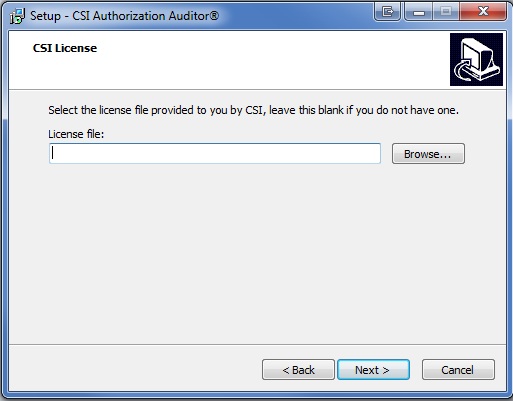
At this step you can browse for your license file which grants you access to your CSI Authorization Auditor. If you do not have this file at installation time, you can skip this step but keep in mind that you will need to link the license file at program startup before CSI Authorization Auditor will be functional.
Click next to continue.
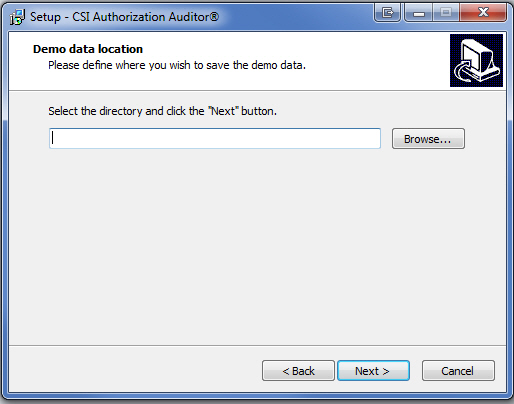
Please indicate the location where you wish to save the demo data which is provided when installing CSI Authorization Auditor.
We recommend to use a user-specific directory such as My Documents. A valid folder must be selected in order for the installation to proceed. Click next to continue.
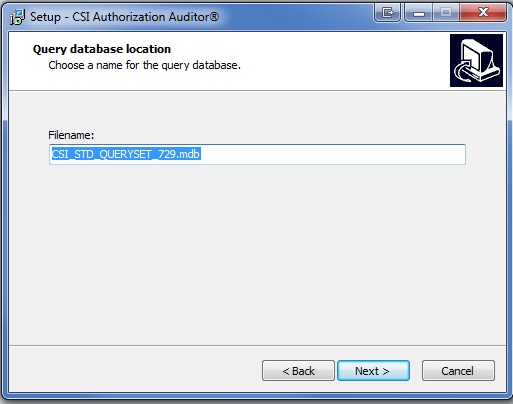
Please choose a name for the query database. Click next to continue.
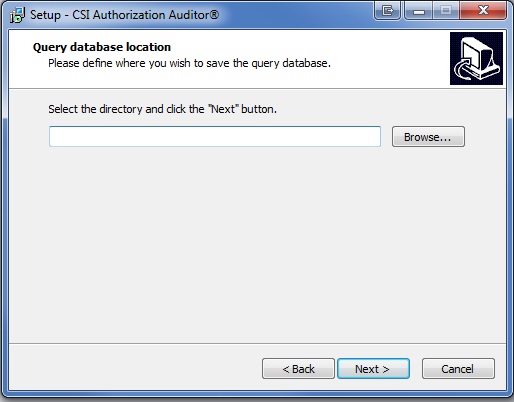
Please indicate the location where you wish to save your query database. We recommend to use a user-specific directory such as My Documents. A valid folder must be selected in order for the installation to proceed. Click next to continue.
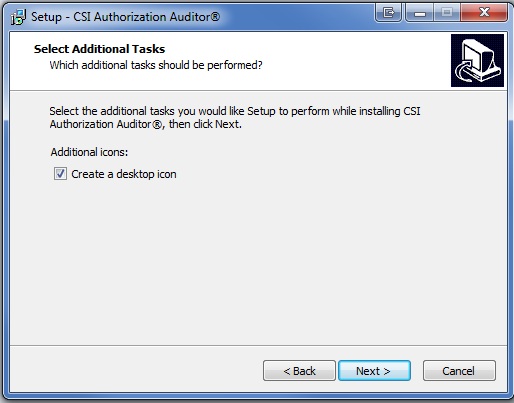
When desired the installation process can place a shortcut to the CSI Authorization Auditor on your desktop. Click next to continue.
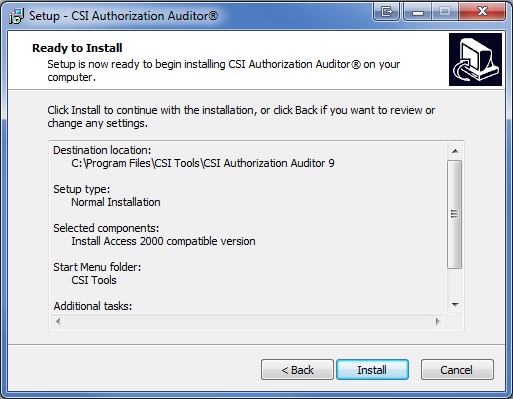
This part of the setup allows you to review the installation settings before the actual installation begins.
Click install to continue.
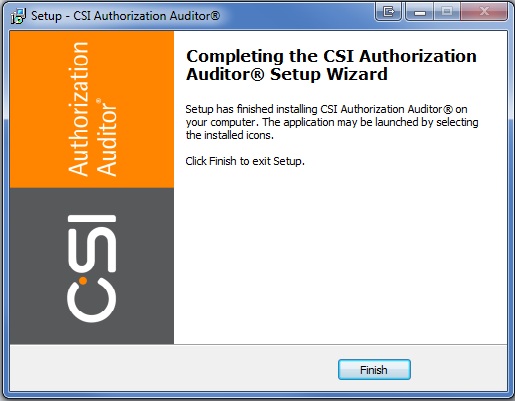
All files have now been copied and installed.
There are two ways to launch the CSI Authorization Auditor:
CSI tools BVBA © 2012 - All Rights Reserved